
PURBACHAL NEW TOWN
DHAKA
Bangladesh
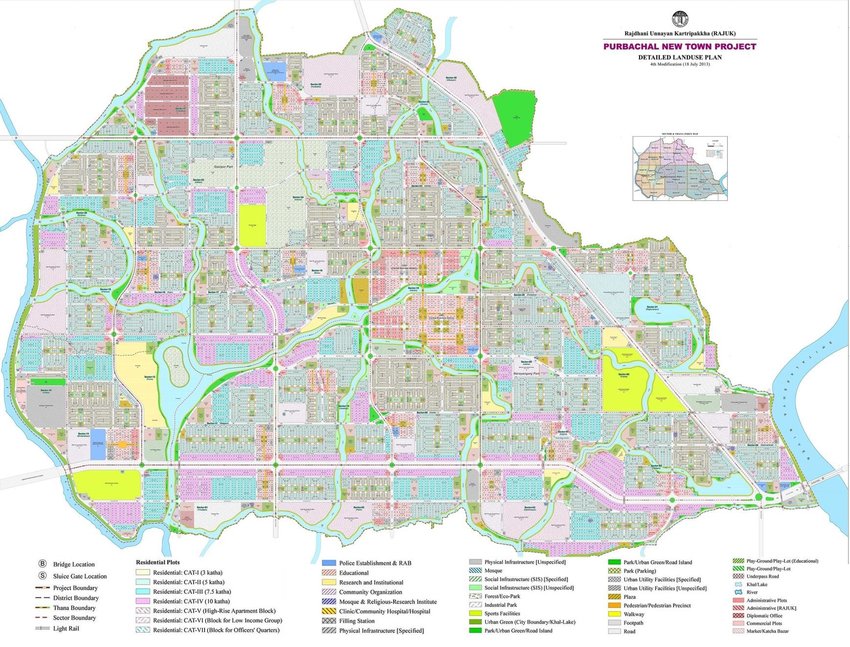
Purbachal New Town is the largest planned township in Bangladesh, undertaken by the Rajdhani Unnayan Kartripakkha (RAJUK), the capital development authority. Project was initiated in 1995, a key component of the urbanization strategy for the Dhaka Metro Region. The primary objective of this monumental project is to reduce the extreme population pressure on the capital, Dhaka, and mitigate its acute housing problems by creating a self-contained, modern, and environment-friendly residential area in its vicinity.
Purbachal New Town covers a vast area of approximately 6,213 acres (about 25.14 square kilometers). The land is strategically located on the northeastern side of Dhaka, distributed between the Rupganj Upazila of Narayanganj district and the Kaliganj Upazila of Gazipur district, bordered by the Balu River to the west and the Shitalakhya River to the east. It is situated about 16 kilometers from the zero point of Dhaka city. The plan includes the provision of approximately 26,000 residential plots of various sizes and 62,000 apartments, complete with essential infrastructure and urban amenities.
Future Cities criteria compliance
Environmental & Nature
The project’s objective is to create a sustainable and environment-friendly atmosphere. The master plan dedicates significant area for environmental features: 7.1% for lakes and canals and 6.6% for urban green and open spaces. Planners aimed to minimally disturb the existing topography, converting low-lying areas into interconnected lakes and canals to enhance drainage and water conservation.
Smart City
Purbachal New Town is planned as Bangladesh’s first “smart city” with modern, integrated technology. It includes provisions for a separate water supply, sewerage system, dedicated waste treatment, and an independent power system to ensure uninterrupted utility services. Key landmarks, like the Bangabandhu Tri-Tower Project, are designed with smart features, including solar glass and a dedicated power station.
Human-Centric
It is designed as a self-sufficient township to improve the quality of life and reduce pressure on Dhaka. The plan includes essential amenities like schools, hospitals, and recreational areas, and uses a grid-iron road network for connectivity. However, comparative studies suggest the plan may have missed opportunities for diversifying density, social mix, and integrating mass transit, which are key to highly liveable, citizen-centred urban design.
Interesting Links
Links to external websites and video features available for cities and developments that apply and are accepted as Official Participants: click here to apply